• Skip to main content
  • Skip to primary sidebar
  • Skip to footer
- Plan Your Next Adventure -

Deneki Outdoors

Alaska | The Bahamas | Chile

  • About
    • Jobs
    • Blog
  • Locations
    • Rapids Camp – Bristol Bay, Alaska
    • Alaska West – Western Alaska
    • Andros South – The Bahamas
    • Rio Salvaje – Chile
  • Air Taxi Service
  • Memberships
  • Search

Bonefish

Mar 13 2017

Bonefish Flies – Weight Matters

Selecting bonefish flies
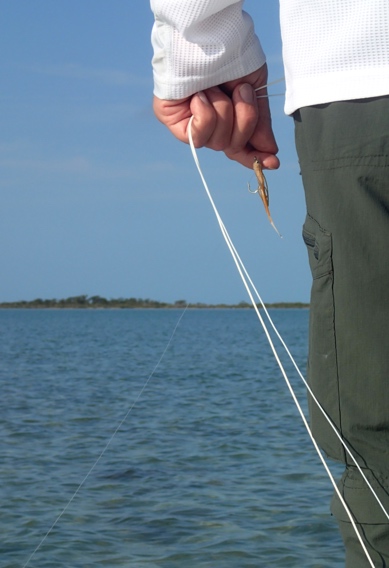
Knee-deep water, medium bead chain eyes, good choice. Photo: Chris Wilks.

We’ve said it many before, but when it comes to selecting bonefish flies for South Andros, our fish aren’t overly picky. Many, many different fly patterns work well on our flats, so when choosing flies we prefer to focus on a few basic variables for the situation at hand, rather than a particular fly pattern.

Arguably the most important variable of all when selecting a bonefish fly, however, more so than the overall pattern, color, or even size, is the weight of the fly. The weight determines the depth the fly is fished, and in turn, whether or not it is easily seen by the fish! After all, a fish has to be able to see your fly to eat it, right?

All too often anglers blame their fly pattern when a bonefish does not commit, deeming it a ‘refusal,’ when more likely it was the depth at which the fly was tracking when stripped.

But how exactly do you know how heavy of a fly to use? Long time Andros South guest, Wayne Walts, recently shared a simple formula he uses on a regular basis for selecting flies for the depth of the water at hand. We think it’s pretty spot-on, so today we share it with you.

When the water is..

  • Calf-deep or less: Choose a fly with small bead chain eyes.
  • Knee to calf-deep: Choose a fly with medium-large bead chain eyes.
  • Knee-deep or deeper: Choose a fly with brass or lead eyes.

According to Wayne, assuming your average bonefish is cruising somewhere around 3-5 mph, doing so will allow the fly to reach the bottom in roughly three seconds, just enough time for the fish to intercept. Simple as that!

More on Bonefish Flies

  • Selecting Bonefish Flies
  • Bonefish Fly Selection for Andros South
  • Our Favorite Flies for South Andros

Filed Under: Andros South, Tips Tagged With: Bonefish, flies

May 27 2016

Bonefishing Tip: Adjusting Fly Weight on the Water

Adjusting weight of your bonefish fly on the water.
What you’ll need. Photos: Michael Gracie. 

Today we present you with a super clever tip (and some well deserved snarkiness) courtesy of long-time Deneki pal, Michael Gracie, on how to quickly change the weight of your bonefish fly while on the water.

Take it away Michael!

Adjusting Fly Weight on the Water

The Shea’s Bonefish Buttah has become one of my go-to flats flies. I don’t suggest it just for South Andros, nor do I intimate just for bonefish; it’s a large profile shrimp pattern that has just the right blend of fibers, color, and fish maddening antennae to look alive. And we all know prowling flats critters love alive.

I say this without bias. I mean I don’t even like Kyle Shea. Who would? He gets to spend winters on South Andros Island. Meh. (Reminder to myself to sock him square in the nose next time I see him).

Back on the serious track.. Yeah, the Bonefish Buttah kicks it, and it’s primary value is it looks big but lands soft. It sinks slow, fluttering (and screaming) meaty goodness until it hits bottom and looks for somewhere to hide. Perfect for skinny water. That can also be it’s handicap.

We’ve all been presented with situations where we are poling along a shallow flat, and all of a sudden we happen upon two feet. Fish are sighted, but the fly just doesn’t hit bottom quick enough. So we change flies, something we are loath to do considering we already have something tied on that we’re confident in. You’re not at the tying vise, but this is where having a spool of 0.015 lead wire comes in really, REALLY handy. Here’s how:

  1. Pull three to four inches of wire off the spool.
  2. Start your wrap just below the eye, beginning with the wire around the midway point of its length and make a few wraps there.
  3. Wind the ends of the wire around each bean chain eye and tuck the ends in close to the body.
  4. With your fingernail, push the wire that have strayed onto the eyes in close to the body.
  5. Put a drop of UV Knot Sense on the wraps.
  6. Finally, wait thirty seconds until the adhesive dries, then cast to a pig in several feet of water. Your special fly will now drop quickly right down in front of it’s face. Snort snort … hookup!
Quick, simple, effective.. What more could you ask for?

With this other worldly brilliant – or maybe just common sense – fly-fishing hack, you won’t need to change your fly the next time the depth changes. The rig should last numerous casts, and one to two fish; not bad for a minute of your time, as well as the piece of mind that you are fishing your favorite fly regardless of depth.

A spool of wire can be had for about four bucks at most any fly shop. About the same cake as I spent per fly to corner the market on Shea’s Bonefish Buttah online last week.

MG signing off (to keep my Buttahs tied on, no matter how deep the water is).

More Bonefishing Tips

  • Selecting Bonefish Flies
  • Rub Your Fly in the Sand
  • Pivot Slower

Filed Under: Andros South, Tips Tagged With: Bonefish, flies

Mar 21 2016

Be Brave – Try Something Different

Bonefish on Trout Flies.
This is not staged.. Photo: Doug Jett.

Fly fisherman are a stubborn bunch. We all have our confidence flies – The tried and true patterns we reach for when the going gets tough.

However, in all avenues of fly fishing, the angler who’s willing to experiment is often the most successful in the long run. Trying new flies (even the most off the wall patterns) allows us to learn more about our quarry and become better anglers in the process.

Take the photo above as a prime example. That’s a bonefish, caught by our good friend, Doug Jett, at Andros South. The fly? No, you’re not seeing things – That’s a size 8 Bead Head Pheasant Tail. In fact, that very day, Doug landed over a dozen bonefish on that very fly! Yes, really.

That begs the question – Is the Pheasant Tail the next big bonefish pattern? Probably not. But, we think it goes without saying that sometimes trying something out of the ordinary can pay off.

So, the next time you reach in your box for that gotcha, wooly bugger, clouser minnow, parachute adams, or the like – be brave and try something different. You never know what you might learn!

More Posts on Bonefish

  • 3 Things Bonefish Hate
  • Identifying Bonefish Muds
  • Everybody Blows Shots

Filed Under: Andros South Tagged With: Bonefish, cool pictures, flies

Mar 02 2016

Bonefish Scampi – Tying Instructions

How to tie the Bonefish Scampi, a fly pattern for bonefish.
Mmm Bonefish Scampi. Photos: Kyle Shea.

At Andros South, we generally subscribe to the ‘big fish like big flies’ theory. Just ask long time Andros South guide, Josie Sands, what he likes in a bonefish fly.. “More meat” is likely what you’ll hear.

So, today we’re coming at you with a step by step for a popular bonefish pattern of the ‘meaty’ variety designed by Henry Cowen, the Bonefish Scampi.

By utilizing a rabbit zonker strip, the Bonefish Scampi creates a large profile (which we really like) while offering great movement in the water as well. It’s also a great pattern to get creative with, as virtually every material can substituted for a different color. Keep reading for the step by step instructions of our favorite color combination for South Andros.

Bonefish Scampi – Tying Instructions

Materials:

  • Hook: Daiichi 2546 or Tiemco 811s – Sz. 2-4.
  • Thread: UTC 140 Denier – Fl. Fire Orange.
  • Eyes: Silver Mini Lead Eyes OR Medium Silver Bead Chain Eyes.
  • Tail: Medium Mylar Tubing – Pearl.
  • Body: Flat Diamond Braid – Pearl.
  • Wing: Rabbit Zonker Strip – Tan or Ginger.
  • Over Wing: Craft Fur – Cream.
  • Flash: Kyrstal Flash – Pearl.
How to tie the Bonefish Scampi, a fly pattern for bonefish.
Step 1: Secure thread and tie in eyes at the 1/3 position of the shank using figure eight wraps of thread. We used silver plated lead eyes here, but bead chain eyes can easily be substituted depending on the depth you’re fishing. Keep in mind that rabbit tends to take a little extra weight to sink.
How to tie the Bonefish Scampi, a fly pattern for bonefish.
Step 2: Catch in a length of pearl mylar tubing as a tail and advance thread back to just behind the eyes. Make sure to cover the shank in touching turns with thread. Pick out mylar to allow fibers to move freely as seen above.
How to tie the Bonefish Scampi, a fly pattern for bonefish.
Step 3: Catch in a length of pearl flat diamond braid just behind the eyes.
How to tie the Bonefish Scampi, a fly pattern for bonefish.
Step 4: Wrap the braid down the shank in touching turns (toward the hook point), BUT stop just shy of the tail. This leaves nice looking band of orange at the butt of the fly. Add a touch of super glue and reverse the braid, wrapping over the first layer all the way to the eyes. Cover the eyes with the flat using an ‘x’ pattern and tie off in front of eyes.
How to tie the Bonefish Scampi, a fly pattern for bonefish.
Step 5: Remove the fly from the vise and stick the hook point through the leather of a tan rabbit zonker strip as shown above. Insert the hook so that approximately a 1/4 inch of leather sticks out the back of the the fly as shown.
How to tie the Bonefish Scampi, a fly pattern for bonefish.
Step 6: Slide the zonker strip down the hook bend so that the leather lies flat against the shank of the hook as shown above. Pull the zonker strip tight enough that it lies flat and tie of at the head of the fly. Trim the excess.
How to tie the Bonefish Scampi, a fly pattern for bonefish.
Step 7: Catch in a small clump of cream craft fur as an over wing. For an added touch of class, try coloring some bars on the craft fur with permanent marker (not shown above).
How to tie the Bonefish Scampi, a fly pattern for bonefish.
Step 8: Double over a single strand of pearl Krystal Flash and tie in a strand on each side of the craft fur wing extending slightly longer than the wing.
How to tie the Bonefish Scampi, a fly pattern for bonefish.
Step 9: Create clean tapered head, whip finish, cement, and give it a soak!

More Posts on Fly Tying

  • Fly Tying Tip – Taming Your Flash
  • Finishing Intruders – 9 Options
  • Tube Fly for Barracuda

Filed Under: Andros South Tagged With: Bonefish, flies, fly tying, step by step

Feb 19 2016

Skinny Water Bonefish – Go ‘Blind’

Shallow water fly patterns for bonefish.
A rubber legged gotcha, tied ‘blind.’ Photo: Kyle Shea.

At Andros South, most of the time we like to fish flies that are quite a bit larger than most other bonefishing destinations around the world. Our bonefish aren’t overly picky when in comes to fly pattern, and generally respond better to a bigger meal. Therefore, the majority of the time we prefer flies tied on a size 2 hook. A size 4 would be considered a ‘small’ fly in our neck of the woods, and we rarely ever resort to flies in the size 6-8 range.

We also tend to fish a lot of really shallow water too. So, while we like a large ‘meaty’ fly, we also prefer our flies to be on the lighter side as well. Large flies tied with heavy lead eyes are generally too heavy for most of the flats we like to fish. Thus, most of our flies are also tied with small-medium bead chain eyes.

In other words, ninety percent of the time we prefer flies in the ‘big and light‘ category – a size 2 hook tied with medium bead chain eyes – that will get it done most of the time.

With that said, there are some situations when even a fly tied with bead chain eyes can be too heavy – think water so shallow you can see the fish’s back out of the water, fishing over grassy areas you don’t want to hang up in, or during those rare glassy calm mornings where the fish are on the highest alert. In these types of situations, sometimes its best to go blind – that is, fish a fly with no eyes at all.

The vast majority of bonefish patterns today incorporate some sort of eyes (bead chain or lead eyes). The concept being; you need a lighter fly, simply fish a smaller pattern. However, for fisheries like ours on South Andros, where the fish (especially big fish) like a larger fly, leaving out the eyes is a great way to still deliver a big meal to skinny water bonefish, without spooking them in the process.

So, if you like tying flies, and are planning on fishing for bonefish on South Andros, try tying a few of your favorite patterns ‘blind’, they just might save the day!

More on Bonefish Flies

  • Our Favorite Bonefish Flies for South Andros
  • Selecting Bonefish Flies
  • What’s Your Favorite Bonefish Fly?

Filed Under: Andros South, Tips Tagged With: Bonefish, flies, fly tying

  • « Go to Previous Page
  • Page 1
  • Page 2
  • Page 3
  • Page 4
  • Page 5
  • Page 6
  • Interim pages omitted …
  • Page 12
  • Go to Next Page »

Primary Sidebar

All Blog Posts

Recent Posts

  • Rapids Camp Lodge: Can’t Miss Opportunity to Fish Alaska
  • Alaska West in July: Either Lucky You or Someone Else’s Mistake
  • The Alaska Spey Box: 7 Proven Spey Patterns That Work
  • Muddler Minnow: A Step By Step Fly Tying Tutorial
  • Bangin’ the Banks on the Kanektok: 6 Tips for Better Fly Fishing From A Boat

Top Posts

All About Spey

All About Trout

All About Bonefishing

All About Gear

Subscribe

Footer

  • Facebook
  • Instagram

Photography by Matt Vaughn, Peter Viau, Tosh Brown, Abe Blair, Kyle Shea and Kara Knight.

Contact Information

Headquarters:
6160 Carl Brady Dr.
Anchorage, AK 99502

U.S. Information and Reservations:
800-344-3628

International Information and Reservations:
+1 907-563-9788

info@deneki.com

Locations

Rapids Camp
King Salmon, Alaska

Alaska West
Kanektok River, Alaska

Andros South
South Andros Island, The Bahamas

Rio Salvaje
Puerto Montt, Chile

Air Taxi
Alaska

Copyright © 2026 · Deneki Outdoors · Privacy Policy · Site by 21 Designs

We use cookies to ensure that we give you the best experience on our website. If you continue to use this site we assume that you are okay with it.