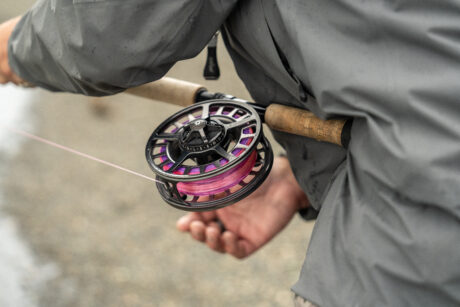
Setting reel drag isn’t complicated. That said many anglers do it by “vibes”, and vibes don’t stop a 40 pound King from spooling you into the backing before you can say goodbye.
Let’s start with an uncomfortable truth, you have probably been running the wrong drag setting for years. You’ve survived this long because fish are occasionally merciful. Kings, chums, and big rainbows are not known for their mercy.
Drag exists for one reason, to create enough resistance to manage a fish without snapping your tippet. It is not a brake. It is not a clutch. It is a carefully calibrated tension between you and something that outweighs your better judgment. Get it right, and you look like a hero. Get it wrong, and you’re watching your fly line disappear at a speed that feels personally insulting.
So here’s how to actually set it.
The Golden Rule: 25–30% of Your Tippet Strength
This is the number. Burn it into your brain. Your drag should be set to roughly one-quarter to one-third of your tippet’s breaking strength. On a 12-pound tippet, that’s 3 to 4 pounds of drag. Not “snug.” Not “feels about right.” Actual measurable pounds.
How do you measure it? Run your line through a hand scale and pull. It takes about thirty seconds and removes all guesswork from the equation. It is the most unglamorous thirty seconds of any fishing trip and absolutely the most valuable. If you don’t have a hand scale, you should obtain one. They have plenty of home uses beyond calibrating your drag.
Respect the Fish That Doesn’t Respect You
A Chinook King salmon, Chum salmon, or BRTs do not know you exist. They are freight trains wearing a fish costume, and when it decides to run, it is going to run whether or not your drag is set properly. Your job is not to stop it. Your job is to annoy it enough that it eventually gives up.
For dense and heavy salmon or trout, maintain your drag slightly lighter than you think you need. A Mack truck of a fish on the take is at peak power. If you lock down too hard early, something breaks, and it won’t be the fish.
- Let it run. If the fish wants to run, let it , and DON’T TOUCH THAT DRAG!
- Keep the tension. Maintain the rod low and parallel to the bank, keep pressure steady, and tighten incrementally as the fish tires.
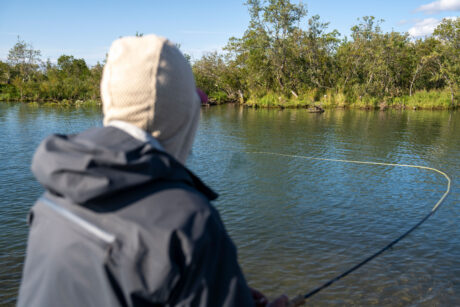
A tired King is a different animal from a hot one. They are still enormous, but they are negotiating instead of fleeing.
Pro tip, on long King runs, use your palm on the spool rim to add supplemental pressure, just don’t clamp down. Think “gentle suggestion,” not “emergency stop.”
Current also matters. Fighting a King salmon across a heavy current puts extra load on your system even when the fish is barely moving. Account for this. Your effective drag is always higher than your dial setting when the river is pushing against your line.
The Field Adjustment You’re Not Making
Here is the other thing nobody talks about: drag is not a set-and-forget system. Water temperature, current speed, line stretch, and whether the fish just ate a big meal, none of it stays constant. You should be adjusting your drag during a fight, especially on long runs with big fish.
As a big fish tires, tighten slightly. If a rainbow burns toward you, back off. The angler who manages drag dynamically catches more fish than the angler who dialed it in at the truck and hasn’t touched it since. The reel has a knob. Use it. That’s why it’s there.
One Last Thing
Check your drag before every session. Drag washers wear out. Mechanisms get grit in them. A drag that felt perfect in May may be inconsistent in September, and you will discover this at the exact worst moment, when something heavy and fast is attached to the other end of your line and running for the ocean.
Setting drag properly is one of the few things in fly fishing that is almost entirely within your control. The fish’s size isn’t. The weather isn’t. Whether there’s a big fish in that run isn’t. But 25% of your tippet strength, confirmed with a scale, adjusted through the fight? That part is yours.
Finally, when you’re done fishing for the day, don’t forget to loosen your drag all the way done. This way you prevent any warps in your drag system.
Happy Draggin’!

Leave a Reply