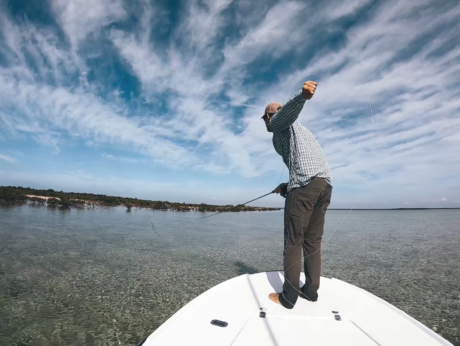
There’s an art to making a bonefish eat—and it starts the moment your fly hits the water. The cast might get you in the game, but the strip seals the deal. Too fast, and you’ll send that grey ghost packing. Too slow, and it’ll sniff your fly like it’s day-old bait. Get it just right—the perfect blend of tease and tension—and you’ll watch that shadow turn, flash, and charge. Let’s break down the strip that turns followers into hookups.
Whilst stripping for bonefish, keep in mind a couple of things. 1. Always try to keep the same pace as the bonefish. 2. Be mindful of the speed of the boat, if you’re on a boat. For the most part, a slow, “medium” strip length will do the trick the majority of the time. That said, even with the smoothest and most proper stripping motion does not make the grade for a bonefish, causing you to question life choices.
Albeit easy to put the onus on the fly, if the bonefish followed your fly, that fish was interested, like the late bloomer swiping right on a dating app. That’s when you examine yourself and take personal responsibility by examining your stripping technique. Let’s explore some ideas to improve your stripping technique.
Stripping Your Fly for Bonefish – 3 Techniques
- The Change Up. The winds are tame, your casting is spot on, you have the guide’s choice when it comes to your fly, and your presentation is suave as the hottest French Bistro and yet you still have no takers. So what do you do? Change up your strip. If you’re using the “most of the time” successful slow, medium strip length, try a quick and really short strip. By changing it up, you can incite attraction by “being different” causing an ignored fly to something exciting and different.
- Let it Dive. So, you can get a bonefish interested and follow for a frustratingly long distance, but it just won’t pounce. What can I do? Try again, but this time, after a little bit of a chase, stop and let the fly dive down to the bottom. This emulates shrimp scampering for cover, hence creating a striking opportunity. When doing this, make sure your spidey sense is on high alert, because if that bonefish stops, that fish is eating your fly, and it’s strip set time!
- Let it Be. A fly that is being stripped toward a bonefish will most likely spook it. Naturally, prey tend to move away from a predator; therefore, your fly (prey) needs to move away from the bonefish. So, if you find your cast and presentation at a particular angle that inhibits a path away from the bonefish, simply let the fly drop to the bottom and let it be. Let it be until that bonefish has moved away from the fly before you engage a stripping motion. Now, consider that the fly does not have to be moving to be ate. Sometimes, being patient and scanning the situation before stripping can result in a take.
The next time you’re knee‑deep on a flat or on the bow of a flats boat while scanning for bonefish with your heart doing double‑time and a bonefish ghosting in, remember—it’s not luck, it’s strip science. Smooth pace, tight line, and perfect timing separate the legends from the “almost” stories. Get those three embedded into your brain, and in no time you’ll turn more follows into eats, more eats into chaos, and more chaos into grinning, sunburned glory. Now get out there and make those bones blush!

Leave a Reply