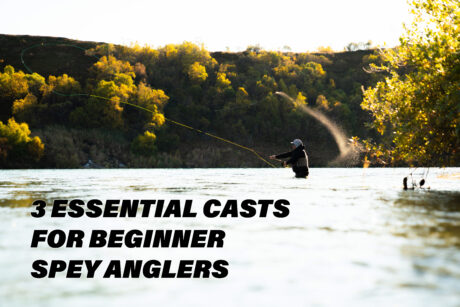
The Two-handed Cast is a beautiful thing. Spey casting is a powerful technique that can revolutionize your fly fishing experience by allowing you to cover more water than a conventional single-handed fly rod. If you’re new to Spey Fishing or using a two-handed fly rod, below are 3 essential casts you should learn first. When considering each of these casts, consider the physics behind each one. By understanding the physics behind these casts, you’ll be able to cast farther, more accurately, and with less effort. Let’s dive into three fundamental Spey casts every beginner should learn.
1. The Roll Cast
The roll cast is the foundation of all Spey casting. Mastering this cast is essential before progressing to more advanced methods.
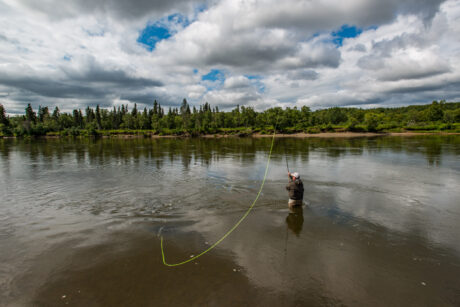
Key Physics: The roll cast relies on the tension between the water’s surface and your fly line to load the rod. As you lift the rod tip, you create a D-loop behind you, which stores potential energy. When you accelerate the rod forward, this energy transfers to the line, propelling it forward.
2. The Double Spey
The double Spey is often easier for beginners to learn than the single Spey, and it provides more time to set up the cast, maximizing, distance, and control
Key Physics: This cast involves creating an anchor point upstream of your position. The anchor acts as a pivot point, allowing you to redirect the line’s energy in a new direction. The key is timing the forward cast just as the anchor touches down.
3. The Snap C or Circle C or Snap T
The C Spey, Snap C, or Circle C is an excellent casting choice for beginners because of its versatility and efficiency. This cast works well in windier conditions.
Key Physics: This cast involves creating a D-loop from an anchor point and transferring energy, similar to the Double Spey, but from a different motion and position.
Understanding the Physics
Understanding the physics of Spey casting is essential for improving your technique and helps you get a better “feel” for the cast. Here are some things to consider:
- Rod Loading: In Spey casting, the rod is loaded through the tension produced between the anchor point and the D-loop.
- Line Speed: Your cast’s efficiency depends on generating and maintaining line speed. This is achieved through smooth acceleration and a crisp stop of the rod during the forward motion.
- Anchor Placement: The placement of your anchor is critical. It should be about a rod’s length away from you, allowing for optimal energy transfer. This will vary depending on your stature and how deep you are wading.
- Two-Handed Power: Unlike single-handed casting, Spey casting relies heavily on the bottom hand for power. The top hand acts more as a pivot point.
By focusing on these physical principles and practicing the three essential casts – the roll cast, double Spey, and Snap C, you’ll be well on your way to becoming a proficient Spey caster. For many situations, those three casts are all you’ll need. Most importantly, mastering these casts takes time and patience. Don’t get frustrated. The rewards for fishing efficiency and enjoyment are well worth the effort. The feeling of a great cast is like a ballet dancer doing the splits while juggling chainsaws – graceful, impressive, and leaving onlookers wondering how you managed to keep all your limbs intact.

Leave a Reply