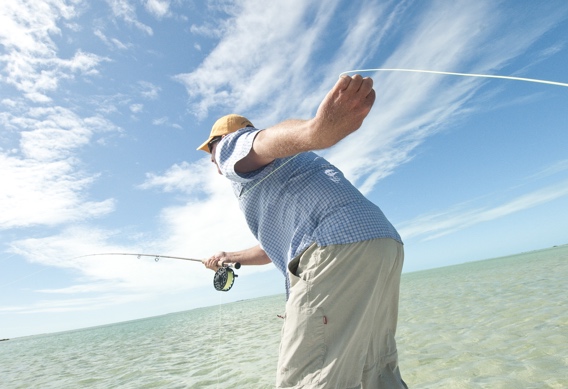
Let’s face it.. We all want to know how to cast further. Regardless of whether it’s necessary to catch fish or not, casting a bunch of line is just plain fun, and certainly a skill worth aspiring to.
Rarely do fish in our neck of the woods require really long casts, but the ability to reach out when it counts doesn’t hurt either. With that in mind, today we present you with 6 tips to help you increase your casting distance. Look out backing, here we come!
Fly Casting for Distance – 6 Tips
First things first, when it comes to distance, there is no substitute for tight loops (a result from a straight-line path of the rod tip) and high line speed (we’re talking an efficient double haul here). However, if you’re comfortable with your double haul, and are able to throw tight loops on a regular basis, the following tips will help you add distance to your cast.
- High Trajectory. The trajectory or better described as the ‘launch angle,’ of the line is extremely important to lengthening out your cast. The trajectory of the cast determines where the loop is directed and is generally a result of the path the hand takes throughout the casting stroke. For short casts, the trajectory of the forward cast should be at a steep downward angle to allow for the loop to unroll just above the target. For a medium distance cast, the trajectory of the forward cast might be near parallel to the surface of the water to allow the line to unroll at just the right time. Therefore, when casting a really long way, the trajectory of the forward cast must be even higher (think aiming at the treetops) in order to allow for the loop to unroll over a longer distance. This is achieved by stopping the rod higher on the forward cast, thus creating a higher ‘launch angle.’
- Drift. For any efficient fly cast, the length of the casting stroke (the distance the hand travels throughout the stroke) must be proportional to the amount of line being cast. In other words, short cast – short stroke, long cast – long stroke. Therefore, when making a really long cast (let’s say 70-100 feet) it’s crucial that we increase casting stroke long enough to carry the appropriate amount of line. We do this using a distance technique called ‘drift’ and you can read a full rundown on it by clicking right here.
- Rock On. Shifting your weight onto your back foot during the backcast and on to your front foot on the forward cast can also help add distance to your cast. Just like drifting, this ‘rocking’ motion helps to lengthen out the casting stroke, thus bending the rod deeper over a longer distance.
- Accelerate Your Haul. Just like your rod hand should accelerate through the casting stroke to an abrupt stop, so should your line hand! Do this by starting your haul slow and smooth and increasing in speed throughout the haul, ending with a sharp snap of the wrist. But, don’t take our word for it.. Read all about it from distance casting guru, Tim Rajeff, here.
- Rod Squeeze. The more abrupt stop the rod can come to at the end of the casting stroke, the more energy is transferred from the rod to the line. In order to stop the rod as abruptly as possible, try incorporating a sharp squeeze of the rod hand at the stopping point. This creates a sharp stop resulting in an efficient transfer of energy from the rod to the line.
- Slide Your Hand Down. In order to cast as far as possible, try sliding your hand down lower on the grip. Some distance casters will go so far as to slide their hand all the way down to the reel. This simple change adds a few more inches to the length of your rod, in effect creating a longer lever. Keep in mind that you may lose some control at first (much like choking up or down on a baseball bat), but your distance potential will be noticeably different.

I through orange backing was what gave you distance?
It’s FARTHER, not further. Further doesn’ have anything to do with distance. It’s like, “Lets look into this further’ kind of thing.